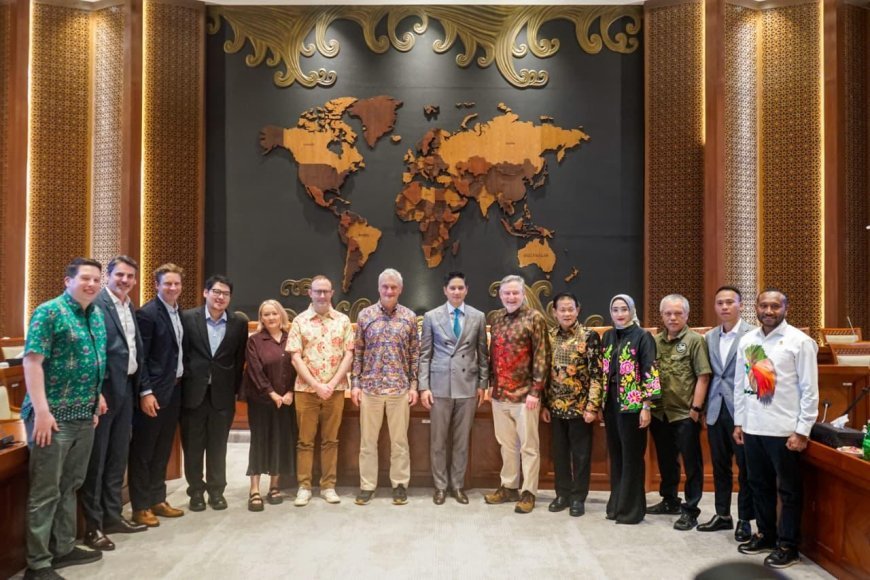
ORCANEWS.ID - The Indonesian House of Representatives (DPR RI) received a visit from the United Kingdom All-Party Parliamentary Group (APPG) on International Conservation, supported by the International Conservation Caucus Foundation (ICCF), in a Parliamentary Hearing held in the DPR RI meeting room, Senayan, Jakarta.
The meeting discussed strengthening Indonesia–UK cooperation in financing national parks through the Public Private Partnership (PPP) scheme, as well as climate avoidance strategies through the conservation of peatlands and coastal ecosystems as part of efforts to address climate change.
The DPR RI delegation in this meeting was led by Mr. G. Budisatrio Djiwandono, Vice Chairman of Commission I of the DPR RI. Also present as members of the delegation were Prof. Dr. Ir. Rokhmin Dahuri, M.S. (Member of Commission IV), Hj. Rina Sa’adah, Lc., M.Si. (Member of Commission IV), H. Husein Fadlulloh, B.Bus., M.M. (Member of Commission VI), Yan Permenas Mandenas, S.Sos., M.Si. (Member of Commission XIII), and Ravindra Airlangga, M.S. (Member of Commission VI).
Meanwhile, the UK delegation attending the forum came from the All-Party Parliamentary Group (APPG) on International Conservation, supported by ICCF, including Barry Gardiner MP from the Labour Party as Chairman of the UK APPG on International Conservation, The Rt. Hon Graham Stuart MP from the Conservative Party, Kerry McCarthy MP from the Labour Party, and Blake Stephenson MP from the Conservative Party.
During the forum, Prof. Rokhmin Dahuri emphasized the importance of spatial planning that supports environmental sustainability. He highlighted that within the spatial planning framework, each island or administrative region should allocate at least 30 percent as protected areas. According to him, reinforcing this policy is essential to prevent recurring environmental damage that leads to natural disasters.
Prof. Rokhmin also stressed that conservation in developing countries such as Indonesia must be understood as an effort to balance economic growth with environmental protection. Conservation should not be viewed merely as closed-off areas without utilization, but rather as the wise management of natural resources and ecosystems for the greatest sustainable benefit of humanity.
In addition, the forum highlighted Indonesia’s significant potential in developing blue carbon. As the world’s largest archipelagic country, with around 70 percent of its territory consisting of oceans, Indonesia has a substantial capacity for carbon sequestration, particularly through mangrove ecosystems, which have a much higher carbon absorption capacity than terrestrial forests. Therefore, mangrove rehabilitation, including in abandoned aquaculture areas, is considered a strategic step to strengthen Indonesia’s contribution to global carbon absorption.
Through this forum, the DPR RI reaffirmed the importance of parliamentary diplomacy in strengthening international collaboration in conservation, biodiversity protection, climate change mitigation, and the development of sustainable financing models to safeguard Indonesia’s strategic ecosystems. The DPR RI also views support from developed countries, including in funding and technology, as a crucial factor to ensure that conservation efforts can proceed in line with national development needs.
The House of Representatives of the Republic of Indonesia (DPR RI) hosted a delegation from the United Kingdom’s All-Party Parliamentary Group (APPG) on International Conservation, supported by the International Conservation Caucus Foundation (ICCF), in a Parliamentary Hearing held at the DPR RI complex in Senayan, Jakarta.
The discussion focused on enhancing Indonesia–UK collaboration in financing national parks through Public Private Partnership (PPP) schemes. It also explored climate avoidance strategies, particularly through the conservation of peatlands and coastal ecosystems, as part of broader efforts to tackle climate change.
The Indonesian delegation was led by Mr. G. Budisatrio Djiwandono, Vice Chairman of Commission I of the DPR RI. Other members included Prof. Dr. Ir. Rokhmin Dahuri, M.S. (Commission IV), Hj. Rina Sa’adah, Lc., M.Si. (Commission IV), H. Husein Fadlulloh, B.Bus., M.M. (Commission VI), Yan Permenas Mandenas, S.Sos., M.Si. (Commission XIII), and Ravindra Airlangga, M.S. (Commission VI).
The UK delegation comprised members of the APPG on International Conservation, including Barry Gardiner MP (Labour), Chairman of the UK APPG on International Conservation; The Rt. Hon Graham Stuart MP (Conservative); Kerry McCarthy MP (Labour); and Blake Stephenson MP (Conservative).
In his remarks, Prof. Rokhmin Dahuri underscored the urgency of spatial planning policies that prioritize environmental sustainability. He noted that ideally, at least 30 percent of every island or administrative region should be designated as protected areas. Strengthening such policies, he argued, is crucial to preventing recurring environmental degradation and the disasters that often follow.
He further emphasized that, for developing countries like Indonesia, conservation should be framed as a balance between economic development and environmental stewardship. Rather than viewing conservation as restricting use, it should be understood as the responsible and sustainable management of natural resources for long-term human welfare.
The forum also highlighted Indonesia’s vast potential in blue carbon development. With approximately 70 percent of its territory consisting of marine areas, Indonesia has a strong capacity for carbon sequestration, particularly through mangrove ecosystems, which can absorb significantly more carbon than terrestrial forests. As such, mangrove rehabilitation—including the restoration of abandoned aquaculture ponds—was identified as a key strategic priority.
Through this engagement, the DPR RI reaffirmed the vital role of parliamentary diplomacy in advancing international cooperation in conservation, biodiversity protection, climate action, and sustainable financing mechanisms. It also stressed the importance of support from developed countries, particularly in terms of funding and technology transfer, to ensure that conservation initiatives can progress alongside national development priorities.